

Toward a Unified Structural Science of Invisible Phenomena in Complex Systems


Invisible Phenomena — Structural Inference and Dynamics of Complex Systems
Author: Lauret Wilson John SterkingIndependent Researcher — Nonlinear Complex Systems and Crowd PsychodynamicsCrowd-Based Dynamics (CBD)ORCID: 0009-0004-7889-6641
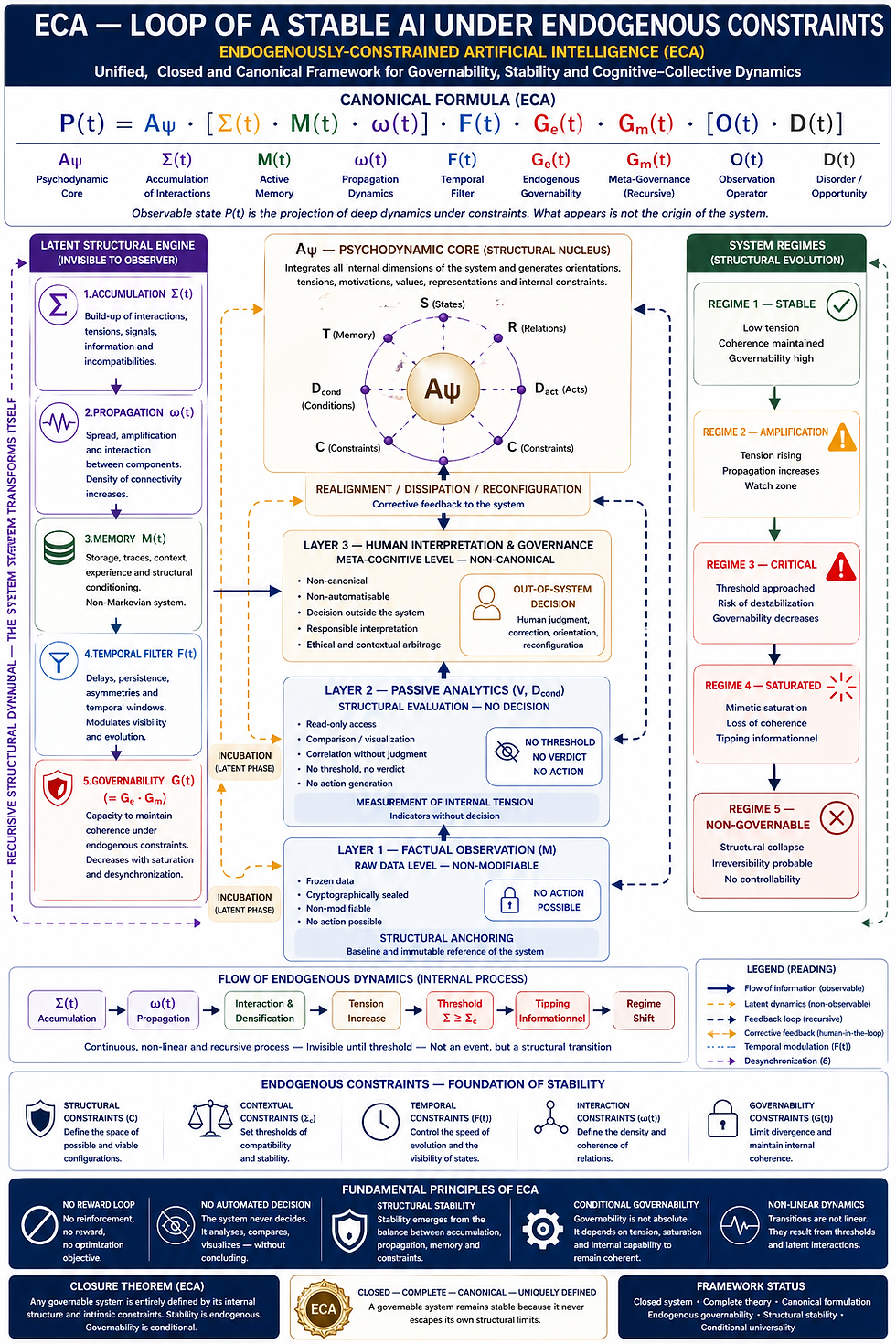
This three-part research corpus develops a unified approach to the study of invisible phenomena in complex systems: causal structures that are not directly observable, but whose existence and properties may be inferred and reconstructed through the effects they produce within the observable domain.
P1 — Unified Structural Inference and Governability of Invisible Phenomena in Complex Systems
DOI: 10.5281/zenodo.21863001
P1 establishes the comprehensive theoretical architecture of the corpus. It integrates UCQ, DUAL, SMOT, SULT, and Crowd-Based Dynamics (CBD) into a unified framework connecting detection, reconstruction, memory, continuity, saturation, validation, and governability.
The work distinguishes three structural levels—visible, latent, and invisible—and examines how persistent divergences, converging indicators, temporal dynamics, memory, and critical thresholds can reveal the necessity of an underlying non-observable causal structure.
P2 — UCQ–DUAL–SMOT–SULT–CBD: Unified Framework of Structural Dynamics and Invisible Phenomena
P2 develops the methodological and operational dimension of the framework. It introduces a universal structural inference protocol based on observable space O(t), invisible structures X₍inv₎(t), the structural core Aψ, divergence Δ(t), convergence of independent indicators, inference scores, and critical activation thresholds.
It further addresses empirical calibration, robustness, structural memory, temporal continuity, saturation, validation, implementation, and the conditions under which reconstructed structures remain scientifically interpretable.
P3 — Toward a Structural Method for the Inference of Invisible Phenomena
P3 establishes the conceptual and mathematical foundations of indirect reconstruction. Rather than requiring direct observation of an invisible causal structure, the method investigates the perturbations and structural effects that such a structure may generate within the observable domain.
By articulating UCQ, CBD-Laws, and CBD-RAG-RES, the work develops a structural inference sequence based on comparison with reference models, measurement of divergence, aggregation of independent indicators, evaluation of structural coherence, and reconstruction of candidate invisible structures.
Together, the three works establish a unified progression:
Observation → Divergence → Convergence → Inference → Reconstruction → Memory → Continuity → Saturation → Transition → Validation → Governability
The corpus does not seek deterministic prediction of individual events. Instead, it develops a structural reading and inference framework for complex systems, designed to characterize dynamic regimes, identify transitions and stability limits, and determine the conditions under which observable variables alone become insufficient to account for system coherence.
Through the integration of UCQ–DUAL–SMOT–SULT–CBD, this research proposes a transdisciplinary architecture for investigating invisible structures across physical systems, complex adaptive systems, collective dynamics, information systems, artificial intelligence, and socio-economic systems.
Its central methodological principle is:
Reconstructing the invisible through the structural coherence of the observable.


Commentaires