

SMOT — Sterking Memory Operator Theory and the Structural Limits of Stability
- Crowd Consciousnes

- 20 avr.
- 1 min de lecture
Dernière mise à jour : 29 avr.
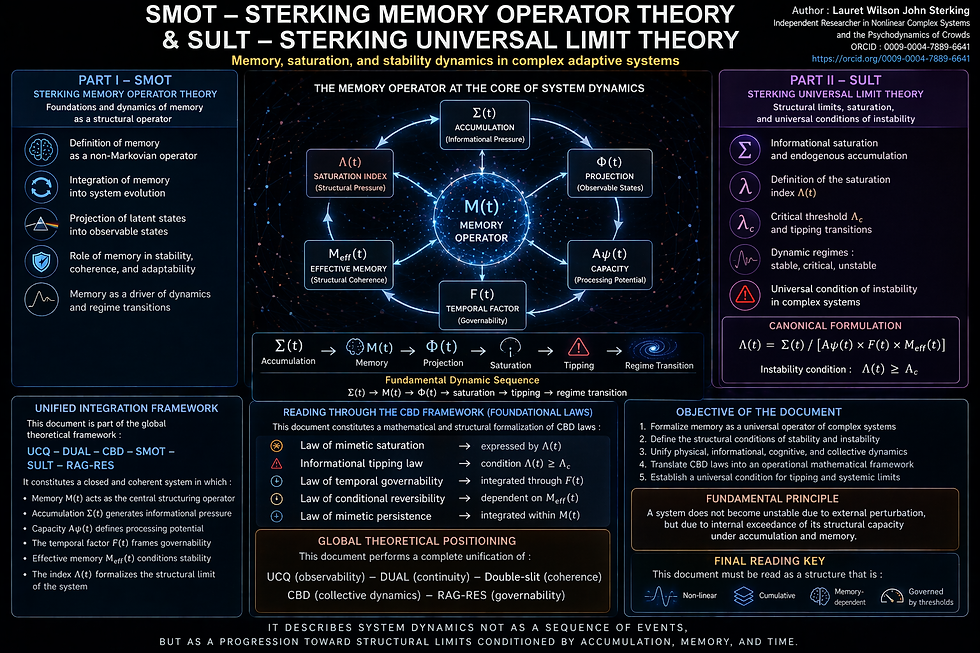
SMOT (Sterking Memory Operator Theory) introduces a formal framework to understand the role of memory in complex systems.
It defines memory not as storage, but as an active operator structuring system dynamics over time.
The framework explores how past states constrain present configurations and future evolutions.
It establishes the concept of the Sterking Limit as a boundary of structural stability.
Beyond this limit, systems lose coherence and enter unstable or irreversible regimes.
SMOT highlights the importance of temporal accumulation and memory saturation.
It shows how systems can appear stable while internally approaching critical thresholds.
The theory connects memory effects with regime transitions and structural transformations.
It integrates with CBD through saturation, thresholds, and governability limits.
It also aligns with DUAL by linking observable states to latent memory structures.
The framework provides a rigorous basis for analyzing delayed instability and hidden divergence.
Overall, SMOT offers a unified perspective on memory-driven dynamics and the limits of systemic stability (DOI : https://doi.org/10.5281/zenodo.19692918)


Commentaires