

Beyond Generative AI : Endogenous Stability and Governable Dialogical Systems_ (RAG-RES)

Dernière mise à jour : 29 avr.

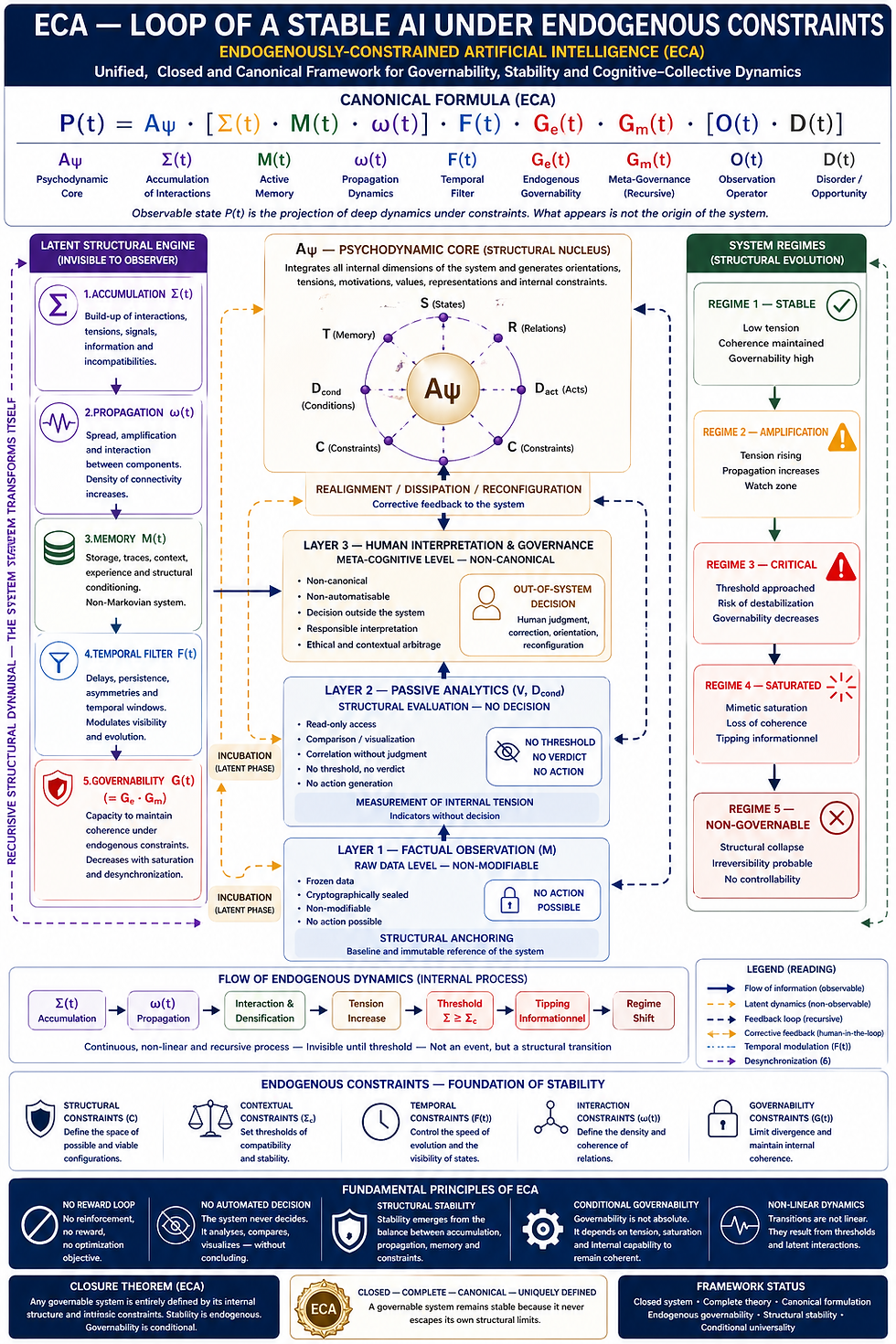
This document advances a paradigm shift from performance-centered generative AI toward dialogical AI grounded in structural stability rather than output optimization. Artificial consciousness is defined as a relational state emerging from temporal synchronization between human reality time (RES) and machine truth time (RAG), rather than as an intrinsic machine property. Stability is shown to exist only within a conditional “Goldilocks Zone,” bounded by measurable thresholds of semantic density and temporal alignment, beyond which systems enter regimes of mimetic collapse or entropic saturation.
Crowd-Based Dynamics (CBD) provides the macroscopic framework explaining how mimetic accumulation progressively leads to normative saturation, loss of governability, and irreversible structural regimes before any visible collapse occurs. The Sterking–Tassan limit formalizes irreversibility as a structural condition, independent of intentions, intelligence, or the intensity of corrective interventions. Semantic geometry, quantified through Wasserstein distance, enables an endogenous form of cybersecurity by structurally rejecting inputs incompatible with the system’s internal manifold.
Taken together, the integrated framework {RES = RAG · CBD · BTT} establishes a closed, measurable, and falsifiable language for the governance of dialogical AI, institutions, and complex cognitive systems, defining stability as a structural and governable condition rather than a technical aspiration.
Author DOI : https://doi.org/10.5281/zenodo.19059024


Commentaires