

Endogenously-Constrained AI (ECA)


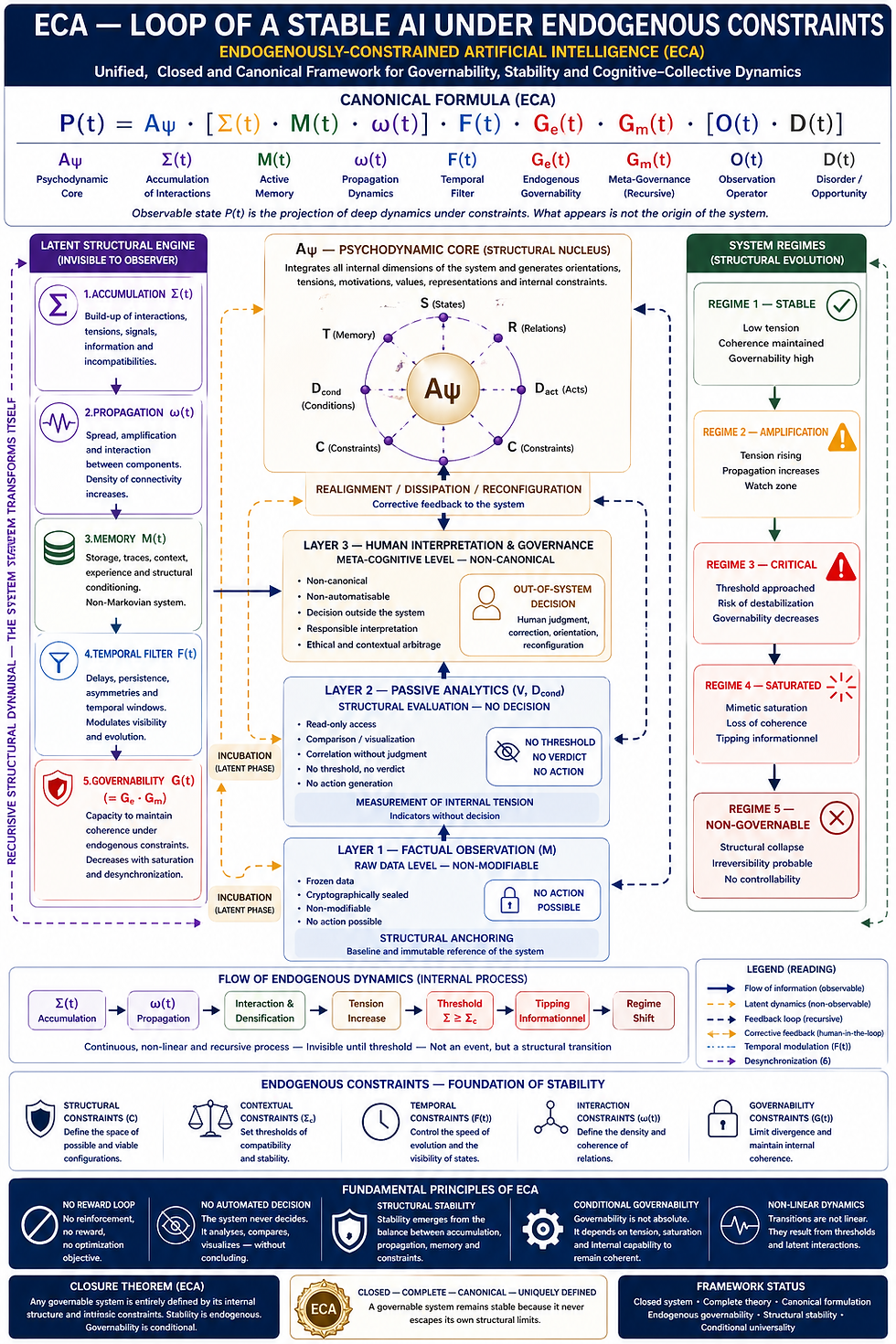
Endogenously-Constrained AI (ECA) proposes a new paradigm for designing stable and governable artificial intelligence systems. It shifts the focus from performance optimization to internal structural coherence and constraint-based stability. ECA models AI systems as complex adaptive systems subject to endogenous limits. The framework emphasizes that intelligence must remain bounded to avoid instability and drift. It introduces constraint operators that regulate system behavior from within rather than through external control. This approach aligns with CBD by integrating saturation, thresholds, and governability into AI dynamics. ECA highlights the role of memory, internal feedback loops, and structural consistency. It addresses risks such as uncontrolled amplification, misalignment, and loss of coherence. The framework proposes that stability emerges from internal constraint rather than imposed regulation. It also explores the limits of scalability and the cost of maintaining system coherence. ECA connects AI behavior with collective dynamics and systemic stability principles.Overall, it defines a path toward auditable, stable, and structurally bounded artificial intelligence systems.


Commentaires